
September 13, 2026
CASE STUDY: INBOX-TO-TICKET AUTOMATION — THE PRODUCT IS THE TRIAGE
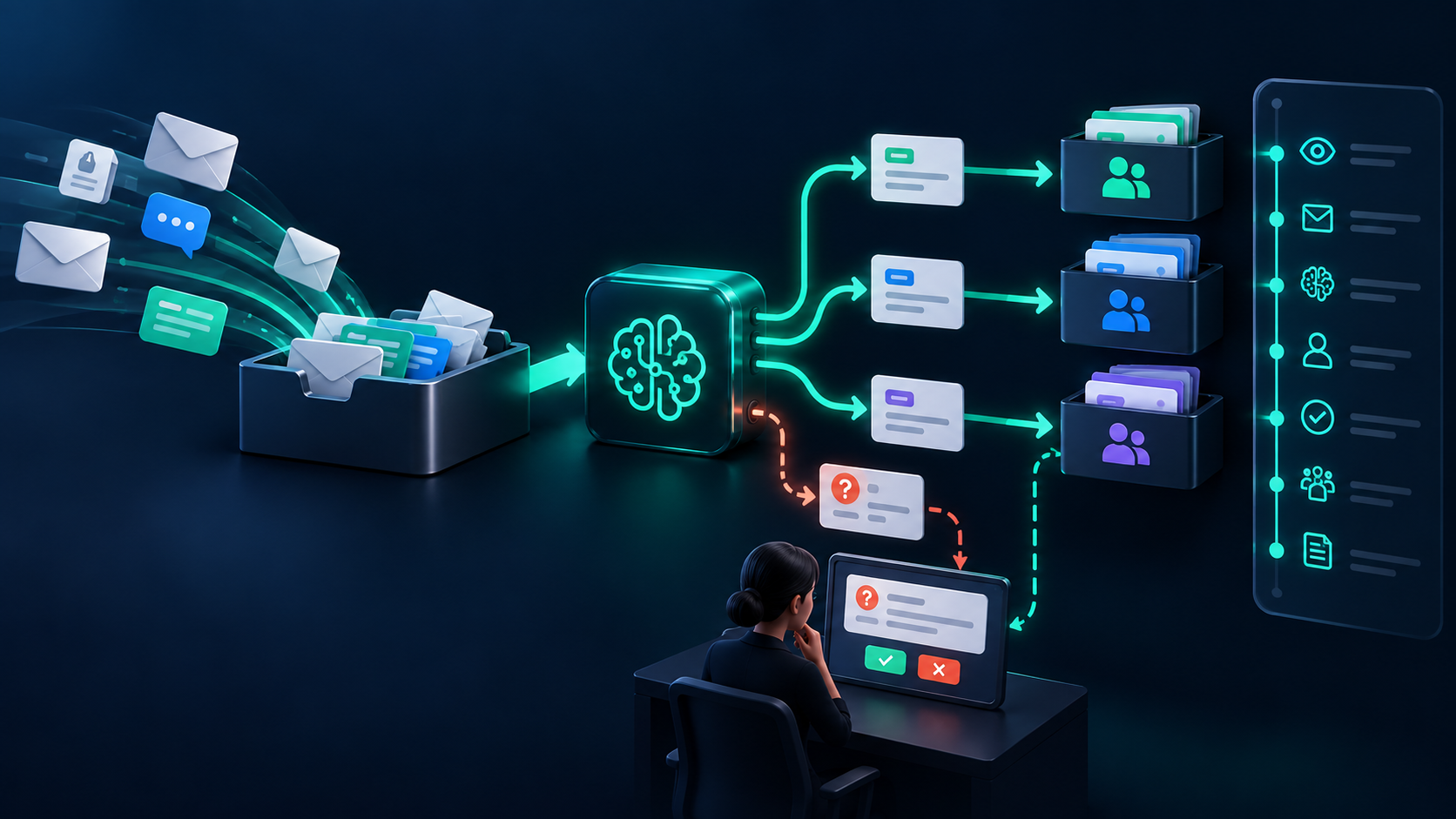
Lessons 56.2–56.5 studied research, mechanic, builder, and answer products. This case studies the shape Lesson 54.6 named: an automation app whose product is recurring triage work — here, a shared support inbox turned into a ticket queue with drafted replies. Read it with the 9-question card from Lesson 56.1; every answer below maps to one row.
The card, filled
- Who is the user? One support lead (and two agents) at a small company drowning in a shared
support@mailbox. Not "everyone with email" — three named people with a daily pain. - Recurring job? Every incoming message gets classified (intent, urgency), linked to account context, turned into a ticket with a drafted reply, and routed. The job recurs dozens of times a day; the manual version is open-every-thread-and-guess.
- Wedge / first useful action? Triage + drafts for one mailbox only. No auto-send except two narrowly defined low-risk replies (receipt confirmations with no promises), each with escalation, logging, and a named owner. Everything else waits in a human queue.
- Inputs, data, models, tools? Trigger: mailbox/webhook or forwarding rule. Workflow: n8n (or Make, or a small worker) — receive, validate, map fields. Agent step: classify intent/urgency, retrieve account + knowledge-base context, draft reply. Writes: ticket + draft + status. Model role: judgment and language inside the workflow, per Part VIII/31.5; the workflow moves the data.
- What must the user trust? That no message is silently dropped, that drafts never send without approval (outside the two explicit auto-replies), that private threads stay permissioned, and that every decision is traceable to the run log.
- When wrong or unavailable? Misclassified urgency → human re-routes from the queue (correction is one click, not a rebuild). Workflow down → mailbox still receives; backlog visibly queues; the morning review clears it. The product degrades to the manual baseline, never to silent loss.
- Reason to return? Tomorrow's inbox is triaged before coffee: the queue, the drafts, and the overnight exceptions. The return loop is the trigger itself — recurrence is built in.
- Distribution path? None needed for v1 — the users are already standing in the pain (their own inbox). This is why automation wedges beat platform launches for first users.
- Too expensive/risky to copy blindly? The approval policy and permission map. Copying the workflow without the "who approves sends" rule and the private-thread boundaries copies the incident, not the product.
Why it works as a product (not just a workflow)
Three properties from Class 55 are visible here. Workflow, not call: the value is routing, approval, CRM context, escalation, audit, and correctable drafts — the model step is one box in six. Narrow, not platform: one mailbox, one ticket destination, one draft format — no multi-channel promise, no "AI runs support." Honest about limits: the two auto-replies are named, everything else is drafted; the product says what it will not do on page one.
The trust mechanics match Lesson 56.5's checklist in miniature: every drafted reply links the retrieved account/order/help-center context it used; uncertainty routes to a human rather than inventing policy; corrections feed back into the classification prompts and knowledge selection (reviewed, per the Class 34 learning loop — never silent self-rewrite).
Transfer it
Take a different recurring flow — lead intake, refund requests, content approvals, nightly stock alerts — and fill the same nine rows. Keep one trigger, one agent step, one approval gate for v1. Name the two auto-actions (if any) explicitly; default everything else to draft-and-queue.
Practical exercise
Fill APPLICATION-CASE-CARD.md for one automation in your own world (evidence level noted per row: observed, reported, assumed). Then answer: what is the wedge, what sends without a human, who owns the exceptions, and what does the user see the morning after go-live?
Finish line: a case card with sources, explicit unknowns, and a one-trigger/one-gate v1 the reader could scope into tasks tomorrow.
ARTICLE DISCUSSION
JOIN THE
CONVERSATION.
Got a question, a take, or a better way to do this? Log in and leave a comment.