
September 13, 2026
UGC MEANS A NATIVE, HUMAN-FEELING CREATIVE FORMAT
In Class 62 you turned one idea into a complete media package: brief, script, visuals, voice, edit, and delivery. That package could be polished and cinematic. Now we change lanes.
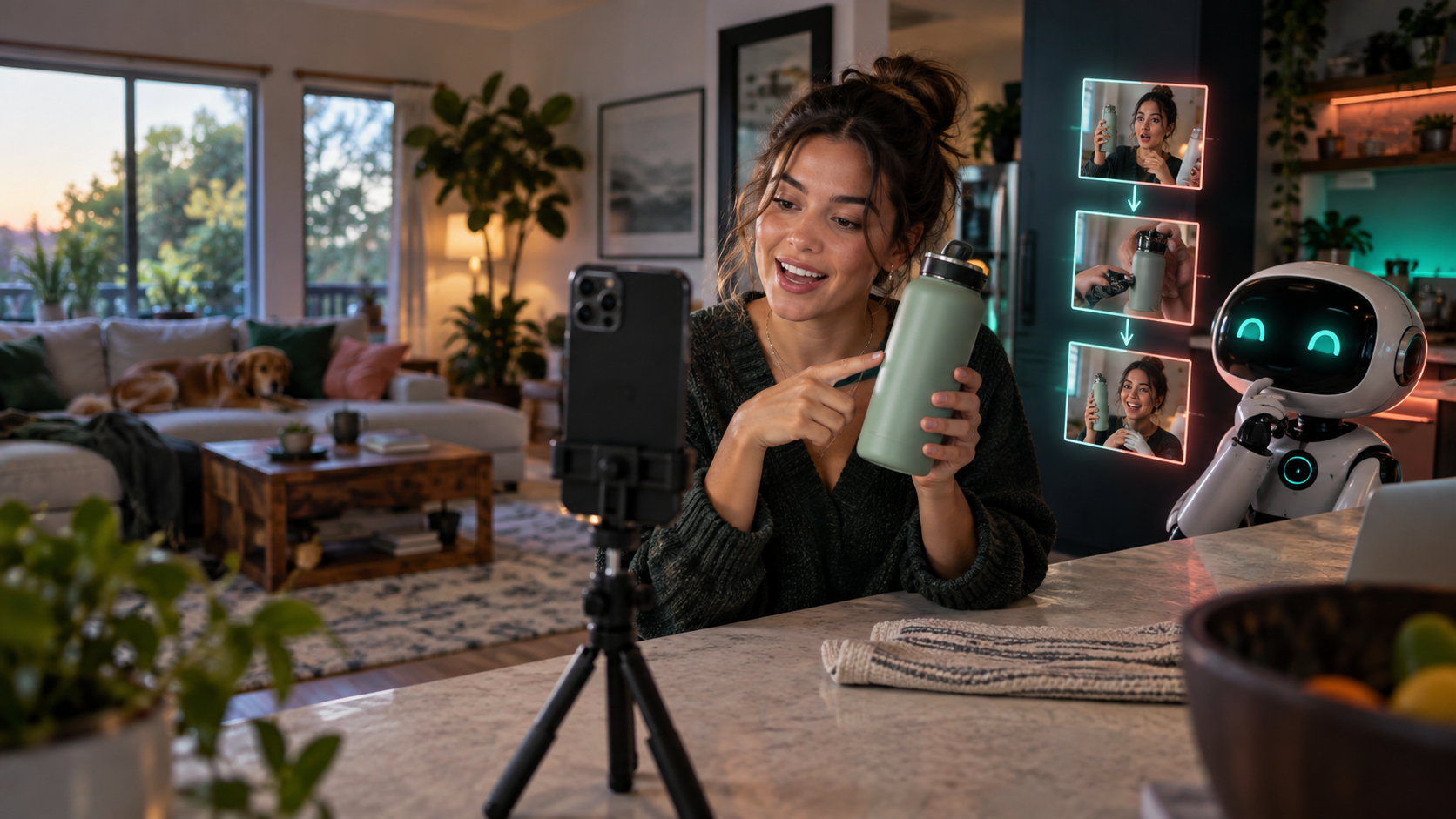
Most of the short video that actually gets watched on TikTok, Reels, and Shorts does not look like a commercial. It looks like a person holding a phone, telling you what happened to them. That is the world of user-generated content — UGC — and this class teaches you to read it, brief it, and reuse it without faking it.
What all these words actually mean
People use UGC loosely. Let's fix the vocabulary first, because each term carries a different promise to the viewer.
- User-generated content (UGC): content made by a customer, fan, or community member rather than the brand itself. A photo of your coffee setup, a 20-second unboxing, a comment-turned-video. The brand may repost it, but it originated with the user.
- Creator content: content made by an independent creator, often paid or gifted, designed to look native to their feed. It borrows UGC grammar even when it is commercial.
- Testimonial: a real person describing their real experience in their own words. "I switched my shop's booking to this app and no-shows dropped." The power depends entirely on it being true and permissioned.
- Review: an evaluation with a judgment. Stars, pros and cons, what worked and what did not. A review implies the reviewer actually used the thing.
- Demonstration: showing the product doing its job on camera. Pour, spray, scan, assemble, before-and-after. The camera is the witness.
- Founder content: the founder speaks directly, usually selfie-style, about why they built something, what they learned, or what changed. It borrows trust from the person behind the product.
- Influencer sponsorship: a creator with an established audience is paid to feature a product. The audience understands — or should understand — there is a commercial relationship.
- Native platform creative: a post made for how people actually consume the feed: vertical 9:16, hook in the first seconds, readable captions, sound that works with or without headphones, room left for interface buttons. It does not feel like a television ad shrunk down.
A paid creator video can *look* like UGC. A real customer video can *be* UGC. The viewer judges both by the same question: does this feel like a person talking to me, or a brand talking at me?
The UGC pattern
Almost every working UGC clip follows the same five-part pattern:
person + recognizable situation/problem
  + product/service
  + specific experience or demonstration
  + natural delivery
Take the local business example from this part: a neighborhood skincare shop launches a fragrance-free moisturizer.
Weak version: "Introducing HydraCalm, our revolutionary formula with advanced peptides." That is a label reading itself aloud.
UGC version: A woman in her bathroom, morning light, no makeup. "My skin freaks out every winter — red cheeks by noon. My esthetician told me to stop layering fragrance. I've used this plain white tube for two weeks." She pumps it, shows the texture on her hand, applies it. "No sting, and my foundation actually sits still now."
Same product. Different structure: a recognizable person, a specific situation, the product shown in use, a concrete experience, delivered conversationally.
Notice what carries the weight: specificity. Winter redness. Two weeks. No sting. Generic UGC says "I love this so much, you guys." Real-feeling UGC names the moment, the action, and the observable result.
Why it works — and what "natural" does not mean
UGC often outperforms polished spots for one reason: it feels closer to how people talk with peers.
A brand spot signals "we paid to persuade you." Your guard goes up. A creator clip signals "someone like me figured something out." Your guard drops enough to keep watching past second three.
But "feels natural" is a craft description, not a permission slip. It does not mean:
- inventing a customer who never existed,
- putting words in a real customer's mouth,
- staging a demonstration the product cannot actually do,
- hiding a paid relationship so it looks like a spontaneous discovery.
A shaky camera does not make a fake story honest. Viewers can tell "unpolished because it is real" from "unpolished as a costume."
The rule for this whole class: natural delivery must sit on top of a true foundation. If the person, the experience, or the proof is manufactured, change the format — use a presenter, an illustration, or a product-only demo — rather than dressing fiction as UGC.
Four formats, four evidence standards
Use this table before you shoot or commission anything. The camera style may look similar. The evidence and permission behind each format are completely different.
| Format | What the viewer believes | Evidence needed | Permission needed |
|---|---|---|---|
| Polished brand spot | "The brand is telling me its message." | Approved claims, accurate product depiction; no real-person endorsement implied | Brand approval; licenses for actors, music, footage |
| Product demo | "I am watching the product work." | The shown action must be real and repeatable; close-ups must match the actual product | Owner approval; do not alter labels, size, or result |
| Real customer testimonial | "This person actually used it and this is what happened for them." | Real customer, real use, their own words; keep the original recording or written source | Explicit written permission to use name, face, words; right to withdraw explained |
| Creator-style UGC (paid/gifted) | "A creator I follow tried this and is showing me." | Creator actually tried it; only claims the demo or sources support; clear disclosure of relationship | Creator agreement covering deliverables, usage rights, disclosure, and claim limits |
Read the last two rows twice. A testimonial without a real customer is fiction. A creator post without disclosure is deception.
Practice: read three posts like a director
Pick three short ads or posts from your own feed. For each, fill in six lines:
1. Hook: what happens in the first 3 seconds, visually and verbally? 2. Speaker: who is talking, and why should this viewer believe them about this product? 3. Proof: what do you actually see happen — demo, before/after, screen, texture, process? 4. Claim: what is the video asking you to believe? ("Saves an hour," "cleared my skin," "easiest setup.") 5. Target viewer: whose problem is this? Be specific about situation, not demographics. 6. Native or artificial: does it feel like it belongs in this feed? Which detail creates or breaks that feeling — setting, vocabulary, pacing, proof timing, disclosure?
Example annotation, short form:
Do this for all three. You will keep seeing the same failure: a strong hook with no proof, or proof buried after throat-clearing.
Finish line
Create UGC-ANALYSIS.md with three annotated examples using the six fields above, plus one sentence each on what you would keep and what you would change.
Quick verification: hand your file to a friend. Can they name the speaker, the proof, and the claim for each ad without rewatching? If not, your analysis is missing the load-bearing detail.
Common failure mode: summarizing vibes ("feels authentic") instead of naming mechanics. Force yourself to point at the second, the sentence, and the shot where trust is won or lost.
Check your understanding
1. What is the difference between a testimonial and creator-style UGC? 2. Why does specificity ("two weeks, no sting") persuade more than enthusiasm ("I love this so much")? 3. Which format requires a real customer and their own words — and what file proves you have them?
Next
You can now recognize UGC and explain the peer-feel honestly. In Lesson 63.2 you will brief it: a repeatable hook → problem → demonstration → benefit → next-step structure, creator fit, and claim discipline that keeps a 30-second script truthful.
ARTICLE DISCUSSION
JOIN THE
CONVERSATION.
Got a question, a take, or a better way to do this? Log in and leave a comment.