
September 13, 2026
THE UGC BRIEF: HOOK, PROBLEM, DEMONSTRATION, PROOF, AND NEXT STEP
Lesson 63.1 taught you to recognize UGC: a person, a situation, a product, a specific experience, delivered naturally. Recognition is not production. A creator staring at a product with no plan produces rambling footage, vague claims, and an edit nobody can save.
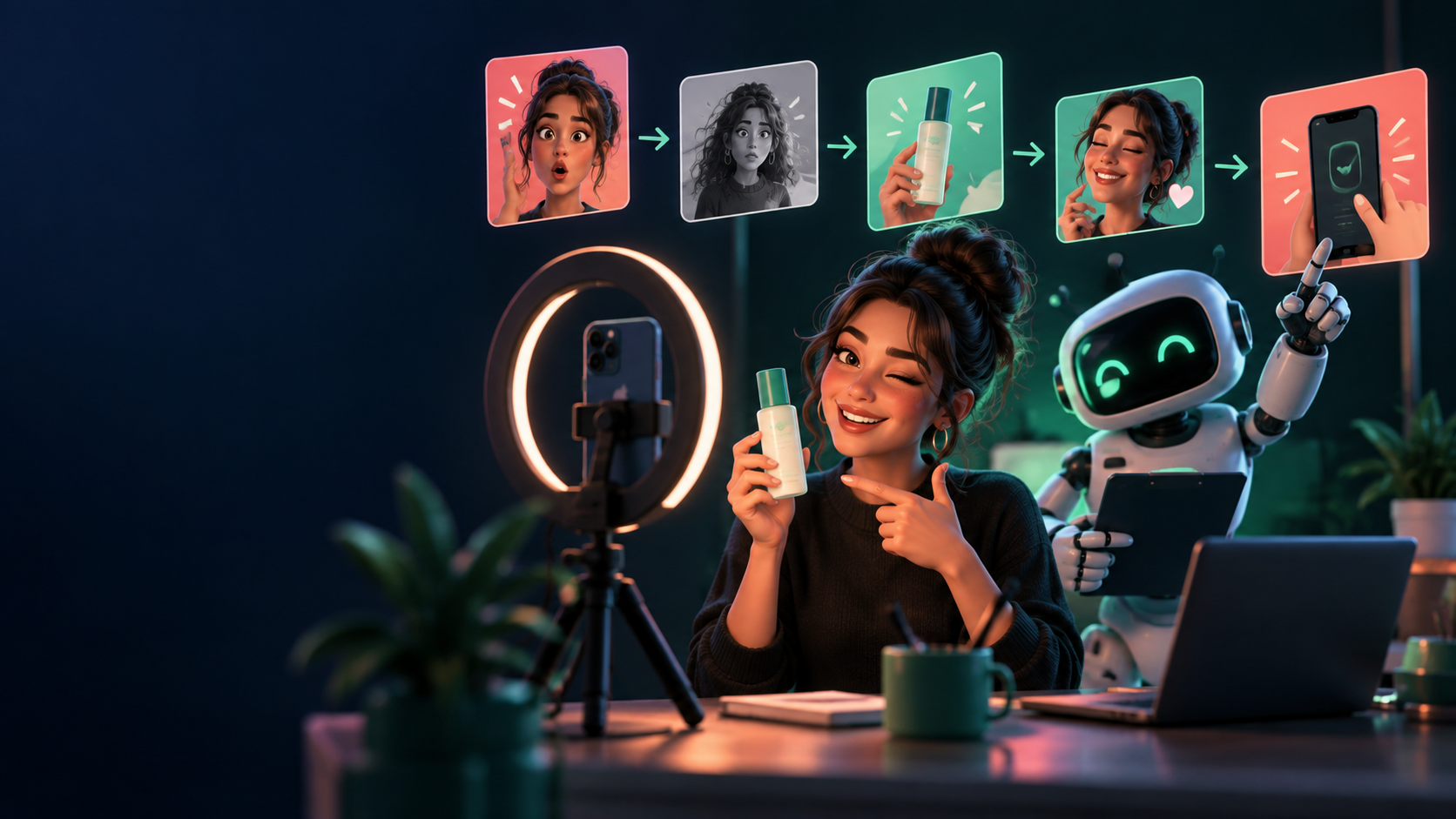
This lesson gives you the plan: a five-beat brief that fits in 30 seconds.
The five-beat structure
Every UGC brief in this class uses the same spine:
hook → relatable problem/context
  → product or method shown
  → specific supported benefit
  → next step
1. Pattern-breaking hook (0–3 seconds). Start inside the moment. Show the stain, the mess, the error message, the before-face. Say the thing the target viewer already thinks. "I kept losing an hour every Monday to expense receipts." Not "Hey guys, welcome back to my channel." 2. Relatable problem/context (3–10 seconds). One sentence of shared pain. Where does this happen, how often, what did you try before? This earns the right to show a product. 3. Product or method shown (10–20 seconds). The camera witnesses the work. Hands, screen, texture, process. No montage that skips the hard part. If you claim it cleans, we watch it clean. 4. Specific supported benefit (20–27 seconds). One benefit, stated concretely, tied to what we just saw. "The pan half I scrubbed rinses clean" beats "revolutionary cleaning power." 5. Next step (27–30 seconds). One action: save this, comment your shade, tap the link, try the sample. Match the ask to the relationship — a cold viewer gets "watch the demo," not "buy the annual plan now."
Run it against the research-story example: Hook shows a confusing chart. Problem: "I kept misreading this dropout stat." Shown: narrator highlights the actual axis on screen. Benefit: "Once you see it is per 100 students, the headline makes sense." Next step: "Source link is below — check table 2."
Same beats, different product. The structure holds because it respects attention: earn it, name the pain, prove something, then ask.
Creator fit: the speaker must make sense
A perfect script dies when the wrong person says it. Check four fits before you cast or film:
- Setting: does the background match the claim? A kitchen demo belongs in a kitchen. A study app belongs where someone actually studies. A borrowed mansion behind a budgeting tip breaks trust instantly.
- Vocabulary: does this person talk like someone who has this problem? An esthetician says "fragrance-free" and "barrier." A busy parent says "no sting and no extra step." Do not hand corporate copy to a human mouth.
- Audience: will this speaker's existing followers believe them about this category? A gaming creator suddenly selling tax software needs a bridge — "I hired three freelancers and messed this up" — or a different creator.
- Category: has this person plausibly used things in this category before? First-time-ever claims ("I've never moisturized until yesterday") usually read as paid fiction unless the story earns them.
For the local business launch: the moisturizer should come from someone with visible winter redness, a plain bathroom, and skincare vocabulary at the right level — not a luxury-haul creator whose feed is all fragrance and filters.
Write one fit sentence in every brief: "Maya, 34, combination skin, films in her own bathroom, talks like a tired parent, audience trusts her routine videos." If you cannot write that sentence, you are not ready to write lines.
Claim discipline: what you can show vs. what you must cut
This is the boundary that keeps UGC honest — and keeps brands out of trouble.
- Demonstrable claim: the camera can prove it right now. "Rinses clean after a 30-second scrub." "Pastes the expense photo into the right column." Keep it, and actually show it.
- Source-backed claim: you cannot demo it in 30 seconds, but a real source supports it. "Dermatologist-tested, fragrance-free" with a test report or ingredient list. Keep it only with the source filed and, where needed, cited on screen or in caption.
- Unverified outcome: a result you hope is typical but cannot show or source. "Cleared my acne in three days." "Doubled my income." Remove or rewrite into what you can honestly say: "My redness looked calmer after two weeks — here's day 1 vs. day 14 under the same light."
Two hard rules:
1. Separate the visual demonstration from the outcome promise. Showing a texture is not proof of a medical result. Showing a dashboard is not proof of revenue. 2. Never write a customer quote the customer did not say. If Maya said "feels gentle," do not upgrade her to "this cured my rosacea." Paraphrase loses trust; fabrication loses the right to publish.
When in doubt, shrink the claim until the proof in your hands is bigger than the words in your mouth.
Practice: three hooks + one 30-second script
Pick one real or fictional product — use the shop moisturizer, a ByeBuy lesson, or your own idea. Do all of this in one file.
Step 1 — Write three hooks. Same product, three different doors. Each hook is a visual + first line, under 3 seconds. Example for the moisturizer:
1. Red cheek close-up: "My foundation separated every winter afternoon." 2. Hand pump texture shot: "Fragrance was the thing breaking me out — not winter." 3. Trash bin with two discarded tubes: "I threw away two moisturizers before this plain one."
Step 2 — Choose one hook and write the 30-second script. Use this table format so visual, audio, and proof stay linked:
| Time | Visual action | Spoken line | On-screen text | Proof / source need | CTA |
|---|---|---|---|---|---|
| 0–3s | Close-up, morning window light, no filter | "My foundation separated every winter afternoon." | Same-day lighting note | None — setup | — |
| 3–10s | Opens cabinet, shows past products | "My esthetician said cut fragrance first, so I tried this plain tube for two weeks." | "2 weeks, AM/PM" | Esthetician advice = personal anecdote, not medical claim | — |
| 10–20s | Pumps pea-size, shows texture, applies to half face | "Pea-size, no scent, no sting around my nose." | "Fragrance-free — see ingredient list" | Demonstrable: texture + no-scent use; source-backed: ingredient list filed | — |
| 20–27s | Split screen day 1 vs. day 14, same light | "Redness looks calmer and makeup sits still till lunch." | "Personal result, not a medical claim" | Personal observation; remove any "cures redness" wording | — |
| 27–30s | Holds tube to camera, smiles | "Sample size is at the shop counter if you want to patch-test." | "Shop address in caption" | — | Visit / patch-test |
Step 3 — Label every claim. After the table, list each factual sentence and tag it: [demonstrable], [sourced — ingredient list v2], or [remove/rewrite — why]. If a claim needs removal, write the replacement line.
Finish line
Create UGC-SCRIPT.md with your three hooks, the five-row script table (actions, lines, text, proof, CTA), and the claim labels with sources or rewrites.
Quick verification: mute the video description and read only the visual-action column. Can a stranger still see the proof happen? Then read only the spoken lines. Is there any promise the visuals do not show and no source covers? Cut it.
Common failure mode: writing the script as captions ("amazing results!") with no witnessed action. If the proof column says "none" for the benefit row, the script is not done.
Check your understanding
1. What are the five beats of the UGC brief, and what job does each do in 30 seconds? 2. Name two elements of creator fit and how a mismatch breaks trust. 3. Your creator wants to say "doctors recommend this." What do you ask for before that line can stay?
Next
You can now brief and script one honest UGC video. In Lesson 63.3 you will stop rebuilding from scratch every time: build a small asset library — clips, facts, proofs, permissions, and hooks — so the next variation starts from approved truth, not a blank chat window.
ARTICLE DISCUSSION
JOIN THE
CONVERSATION.
Got a question, a take, or a better way to do this? Log in and leave a comment.