
September 13, 2026
MUSIC AND SOUND EFFECTS: MOOD IS NOT A SUBSTITUTE FOR RIGHTS OR FIT
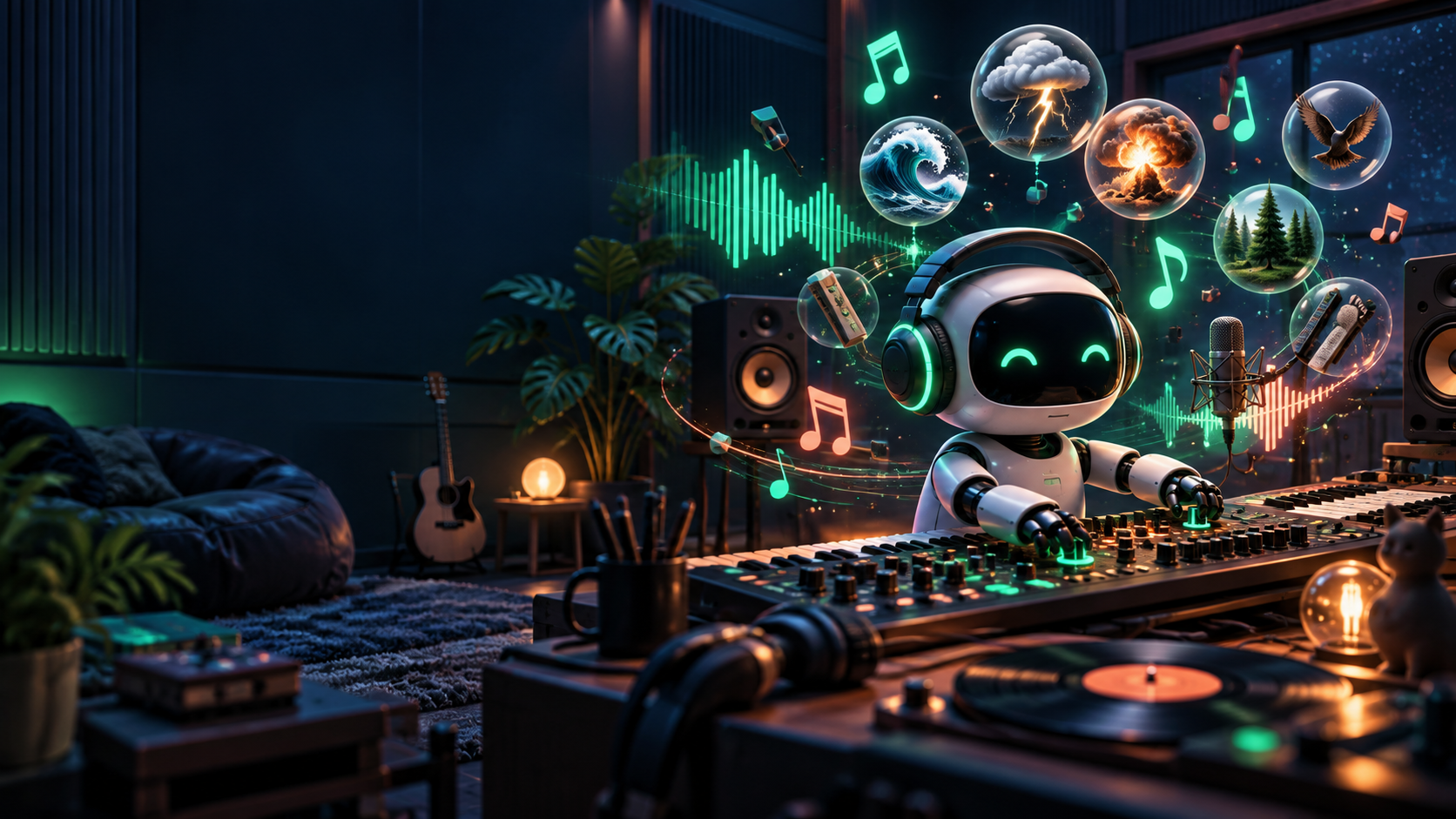
Lesson 61.3 cleaned the voice and balanced the mix. Now the layer that most beginners overuse and most professionals deliberate over: music and sound effects. The right bed makes a 30-second clip feel inevitable. The wrong one drowns the narration, manufactures emotion the claims cannot support, or ships license terms that forbid your actual use.
By the end of this lesson, you can write an AUDIO-BRIEF.md for a 30-second clip and defend a soundtrack direction with fit, rights, and mix notes.
The vocabulary: score, bed, sting, loop, stem, SFX, tempo, mix
| Term | What it means | Typical use |
|---|---|---|
| Score | Composed music written to picture or story | A short film's emotional arc |
| Bed | Continuous low music under speech | Podcast intros, explainer narration |
| Sting | A very short musical accent (1–3 seconds) | Logo hits, transition punctuation |
| Loop | A repeating section that can run any length | Background energy under a montage |
| Stem | An isolated layer of a track (drums, strings, bass) | Removing the drums so narration breathes |
| Sound effect (SFX) | A discrete non-musical sound | Clicks, whooshes, ambient texture |
| Tempo | Speed in beats per minute (BPM) | 90 BPM calm explainers; 120+ BPM energy cuts |
| Mix | The final balance: narration above all, music felt not fought | The -staging where every word stays intelligible |
Learn "stem" early — it is the professional's escape hatch. A track whose drums fight your narrator becomes usable the moment you mute the drum stem.
Where generated music helps — and when something else wins
Generated music and sound tools are genuinely useful in five situations:
1. Placeholder scoring — temp tracks that let you feel pacing before licensing or commissioning. 2. Prototypes and internal videos — work seen by the team, not the public, where speed beats polish. 3. Custom mood exploration — generating six directions ("sparse piano," "low pulse," "warm acoustic") to learn which mood fits before you pay for it. 4. Iterative variations — same idea at three tempos, or with and without drums, for A/B comparison. 5. Unique textures — a strange transition sound no library holds.
And three situations where something else is the better decision:
- Licensed library music wins for most published work: cleared terms, professional mastering, predictable quality. If the video earns money or runs as an ad, start here.
- An original composer wins when the sound *is* the brand — a show theme, a product sonic logo, a score the audience should recognize in two notes.
- Silence wins more often than anyone admits. A serious claim, a delicate testimony, a dense explanation: no bed, no sting, just the voice and room tone. Silence signals confidence.
Default to silence or a minimal bed under narration. Add music to serve the message, never to wallpaper over a weak script.
The review: four questions before you ship
Run every music choice through these four checks:
1. Does it support the message? Energy should match content: curious music under curiosity, steady music under competence. Mismatched grandeur over a settings tutorial reads as parody. 2. Does it distract from narration? The test is intelligibility: can a listener repeat back the key sentence after one hearing? If the bed wins, lower it, thin it (mute stems), or cut it. 3. Does it create false emotion around a serious claim? Swelling strings under revenue numbers, ominous pulses under a competitor's name, triumphant horns under unverified results — music can lie even when the words are technically true. Score the evidence you have, not the reaction you want. 4. Do the terms allow your actual use? Generated tracks carry the generator's license; library tracks carry theirs. Check commercial use, ad use, broadcast, and redistribution rights for your real channel before you fall in love with a track.
A track that fails any one of these is the wrong track, however good it sounds solo.
Build it: the 30-second audio brief
Your exercise: write a brief for a 30-second clip — a product teaser, a lesson opener, a social cutdown:
AUDIO-BRIEF.md — [clip title] — 0:30

AUDIENCE: [who listens, where — e.g. new users, mobile, sound-off-first]
EMOTION: [one word — curious, calm, urgent — plus what it must NOT feel like]
TEMPO: [BPM range + why, e.g. ~100 BPM steady, matches walk-pace demo]
INSTRUMENTATION: [e.g. soft piano + light percussion; no vocals, no heavy drums]
NARRATION SPACE: [e.g. voice enters 0:03; bed −18 dB under speech; drums stem muted 0:03–0:25]
DURATION + EDIT POINTS: [sting at 0:00 logo; breath at 0:15 transition; resolve/out by 0:28]
APPROVAL + RIGHTS: [source: library/generated/composer/silence; license allows (commercial/ads); owner signs off]
SOUNDTRACK DIRECTION: [chosen track + one fallback + mix notes for the final pass]
Worked miniature: a 30-second ByeBuy feature teaser. Audience: new users on social, many starting muted — so the track must work under captions, not carry the message. Emotion: curious, never hyped. Tempo ~100 BPM. Instrumentation: soft synth pulse, no vocals. Narration space: voice from 0:03, bed dropped 18 dB beneath, sting only at the logo hit. Rights: library track cleared for ads; generated alt kept as fallback. The mix note that matters most: "if one word of narration is lost, the music is too loud."
Check your understanding
1. Name three situations where generated music is the right call and two where it is not. 2. What does muting a stem let you do, and when would you reach for it? 3. Your track sounds great solo but listeners cannot repeat the key sentence. What are your three fixes, in order?
Common failure mode: the wallpaper score — full-volume, full-arrangement music wall-to-wall under every second. If your brief has no narration-space line, you wrote a music video, not a narrated clip. Thin it, duck it, or cut it.
The finish line
You are done when you hold AUDIO-BRIEF.md — audience, emotion, tempo, instrumentation, narration space, duration and edit points, approval constraints — plus a chosen soundtrack direction with mix notes the editor can execute.
Next, Lesson 61.5 puts a face on the voice: AI avatars as a reusable presenter layer.
ARTICLE DISCUSSION
JOIN THE
CONVERSATION.
Got a question, a take, or a better way to do this? Log in and leave a comment.