
September 13, 2026
USE AI TO RESEARCH ANGLES AND WRITE BETTER CREATIVE BRIEFS
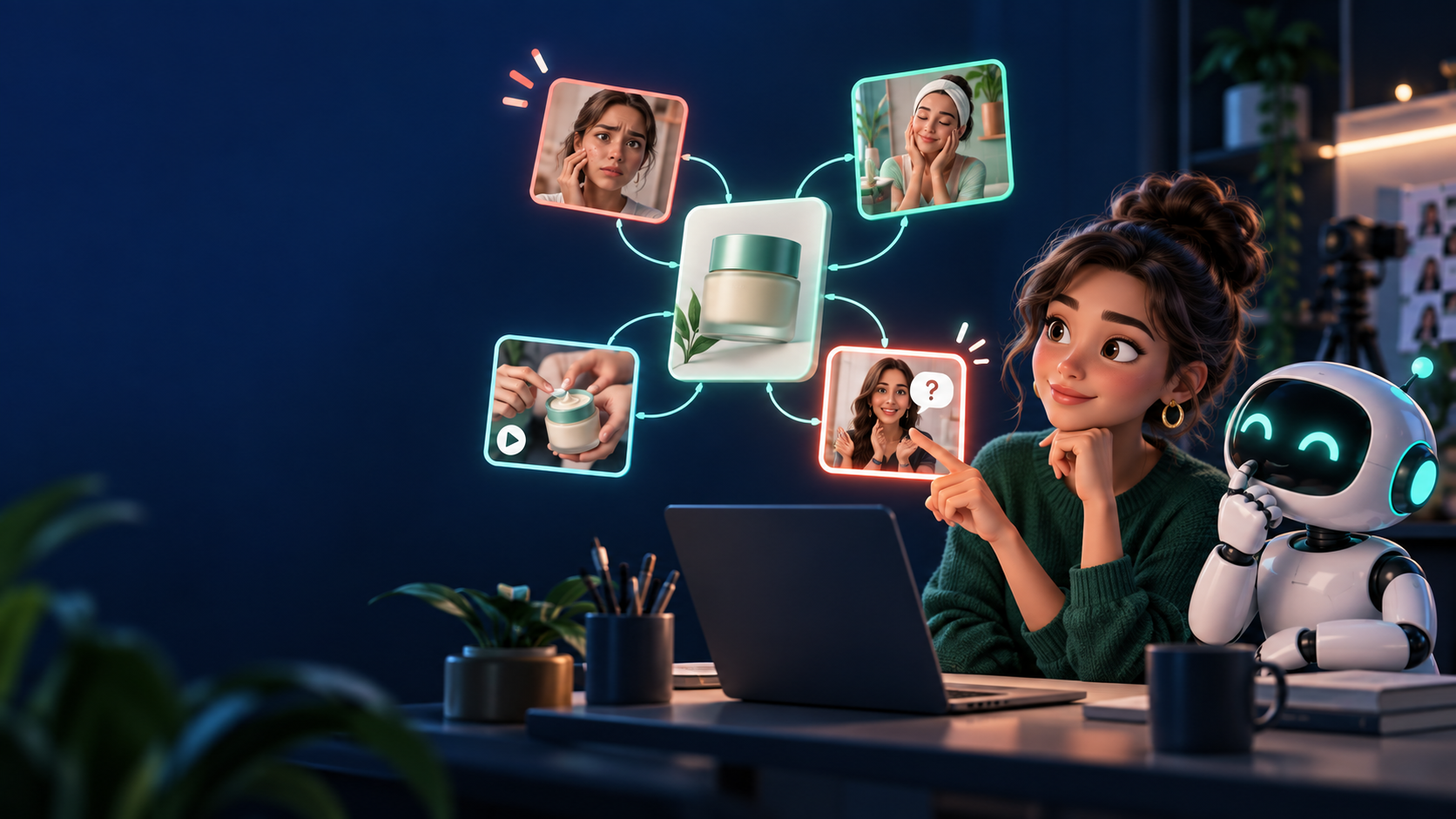
Lesson 63.3 left you with a library: approved clips, facts, proofs, and permissions. Now the question is what to make next. Most creators stare at that library and guess. AI-assisted UGC starts earlier — it uses AI to prepare the thinking, not to invent the truth.
AI prepares, it does not prove
AI is strong at preparation work:
- Summarize approved product information into plain talking points a creator can actually say.
- Organize audience objections into clusters: price, effort, skepticism, fit, timing.
- Generate hook hypotheses — different doors into the same truth.
- Create script variants from one approved claim, not new claims.
- Build shot lists that tie each line to something the camera witnesses.
- Identify questions for a real creator or customer — what only a human experience can answer.
What AI cannot do is supply proof. It cannot taste the moisturizer, patch-test the formula, time the expense app, or remember what the customer actually said. Every angle it proposes must quote back to something you already approved.
That gives the input rule for this whole class:
If you feed it a vague wish — "make this go viral" — it will invent confident fiction. If you feed it a bounded packet — facts, limits, objections, rules — it becomes a fast junior brainstorming partner.
The four approved inputs
Before asking for a single angle, assemble a context file. Four sections, no more:
1. Approved facts. Short verbatim statements with versions. Example: "Fragrance-free, 50ml tube, pea-size covers full face [ingredient list v2]." "Expense photo lands in the correct column in under 10 seconds on office wifi [demo script v1]." 2. Brand rules. Voice, visual constraints, prohibited claims, disclosure requirements. Example: "No medical claims. No before/after lighting changes. Always disclose gifted product." 3. Audience research. Who they are, what they tried, what they ask, what stops them. Use real comments, support tickets, or survey lines — not invented personas. 4. Product limits. What it does not do, who it is not for, what requires caution. "Not for cystic acne. Sample size only at counter, not by mail."
Put these in one Markdown file you can paste or attach each time. When the model quotes from it, you can check the quote. When it drifts beyond it, you can see the drift.
A useful prompt pattern is explicit:
Using ONLY the APPROVED FACTS below, propose 5 creative angles.
Quote the fact each angle uses. Do not add new facts, numbers, or testimonials.
Flag anything you cannot support as [NEEDS PROOF].
The "quote only" instruction is the whole discipline. It turns the model from a fabulist into a librarian.
The brief template: eight fields
An angle is not a brief. An angle says "what if we lead with the trash bin of failed products?" A brief says who it is for, what hurts, what is true, what we offer, what we must never say, what the camera shows, what proves it, and who owns the decision.
Use this template for every angle that survives:
| Field | What to write |
|---|---|
| Audience | One specific viewer in one situation. "Maya, 34, combination skin, winter foundation separation." |
| Pain | The relatable moment in their words. "Foundation pills by lunch." |
| Product truth | The one approved fact this video proves. Quoted verbatim. |
| Offer / next step | The single action matched to the relationship. "Patch-test the sample at the counter." |
| Do-not-say | Banned claims and phrases. "No 'cures,' no 'doctors recommend,' no income promises." |
| Visual constraints | Setting, light, fit, safe area. "Own bathroom, morning window light, vertical 9:16." |
| Required proof | What the camera or source must show. "Half-face application + same-light day 1/14." |
| Owner | Named reviewer who approves facts and brand. "Owner: Priya — fact/brand review." |
Notice what is missing: adjectives, virality goals, trending audio names. Those belong to execution. The brief protects truth first; style serves it.
For the ByeBuy Classroom campaign, a brief might read: Audience — new student confused by context windows. Pain — "I paste more and get worse answers." Truth — "Quoted: smaller, relevant context beats longer context [Lesson 9.2]." Proof — screen recording showing the same question with a short brief versus a dumped thread. Owner — course editor.
Practice: five angles, one winner
Pick one product, lesson, or service. Use your asset library or write a half-page approved-facts section first.
Step 1 — Build the context file. Write APPROVED FACTS (5–8 lines, each with a source tag), BRAND RULES (4–6 do-not-say lines), AUDIENCE RESEARCH (5 real objections or questions), and LIMITS (3 lines). Keep it under one page.
Step 2 — Ask for five angles. Paste the context file and use the "quote only" prompt above. Require each angle to contain: a name, the audience moment, the hook visual + first line, the quoted fact it uses, the proof shot, and one question only a real creator or customer could answer.
Example output shape (moisturizer):
1. The Graveyard. Hook: trash bin with two discarded tubes. Fact quoted: "Fragrance-free [ingredient list v2]." Proof: texture + no-scent application. Creator question: "Which fragranced product actually broke you out?" 2. The Half-Face. Hook: split face, one side applied. Fact quoted: "Pea-size covers full face [demo v1]." Proof: pea-size pump on camera. Creator question: "How much did you use before?" 3. The Lunch Check. Hook: 12pm mirror check. Fact quoted: "Makeup sits till lunch — personal observation, days 1–14." Proof: same-light day 1/14 pair. Creator question: "What does your foundation do by noon?" 4. The Esthetician Note. Hook: phone note screenshot (with permission). Fact quoted: "Cut fragrance first — personal anecdote, not medical advice." Proof: ingredient list on screen. Creator question: "What did your esthetician actually tell you?" 5. The Counter Sample. Hook: hand holding sample at shop counter. Fact quoted: "Sample size at counter for patch-test." Proof: shop counter + address card. Creator question: "What stopped you buying full-size first?"
Step 3 — Select a winner as a human. Score each angle on three questions: Is the fact strong and provable on camera? Does the hook begin inside a real moment? Can this creator say it believably? Pick one, write two sentences explaining why, and list what you rejected and why.
Finish line
Create CREATIVE-ANGLE-BRIEF.md containing your context file (approved facts, rules, research, limits), the five AI-assisted angles each quoting its fact, and your human-selected winner with reasons.
Quick verification: cover the angle names and read only the quoted facts. Are all five traceable word-for-word to your approved section? If any line adds a number, quote, or superlative you did not supply, mark it [NEEDS PROOF] or cut it.
Common failure mode: accepting five angles that are five wordings of the same hook. If the proof shot is identical in all five, you have variants, not angles. Change the situation, the objection answered, or the evidence shown.
Check your understanding
1. What four inputs may you give the model, and what must it never invent? 2. What eight fields belong in the content brief, and what does each prevent? 3. Why must each angle quote its approved fact instead of paraphrasing it?
Next
You have five grounded angles and one winner. In Lesson 64.2 you will turn that winner into systematic variation: one message, many hooks, lengths, and formats — tested deliberately instead of sprayed randomly.
ARTICLE DISCUSSION
JOIN THE
CONVERSATION.
Got a question, a take, or a better way to do this? Log in and leave a comment.