
September 13, 2026
SYNTHETIC PRESENTERS, AVATARS, AND THE TRUST BOUNDARY
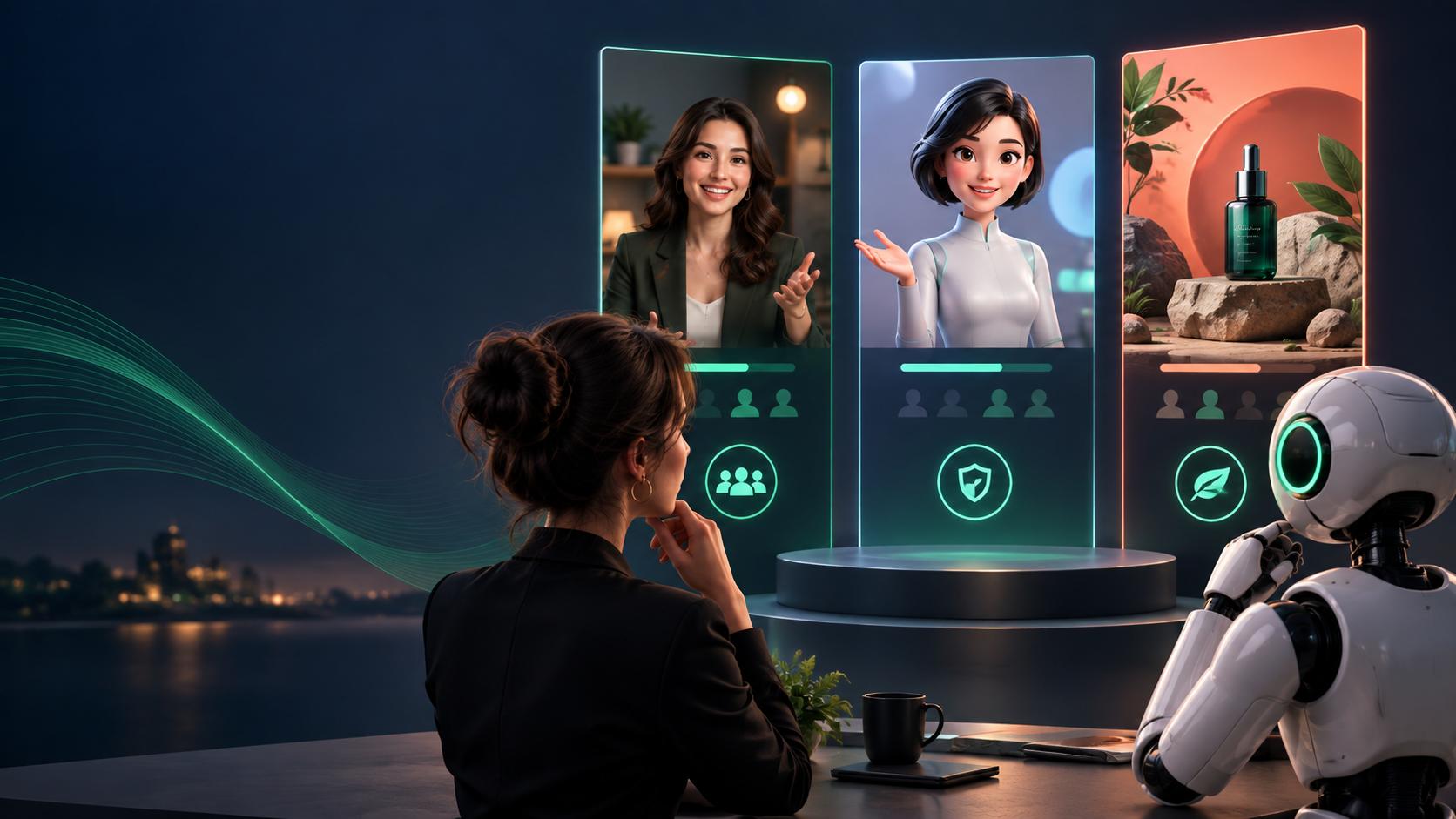
Lessons 64.1 and 64.2 assumed a real person on camera. But AI can now generate the person too — a synthetic presenter, an avatar, a voiceover, a stock-style scene that never happened. Used well, that saves time. Used carelessly, it destroys the thing UGC depends on: belief that a real experience sits behind the words.
Four production types, plainly defined
- Real creator. A real person, filmed or recorded, speaking from their own experience with permission. The audience reasonably believes this person exists and used the thing.
- Synthetic presenter / avatar. A generated face, body, or persona delivering a script — stock-library host, personal digital twin, or designed character. It looks human but no human was filmed saying this.
- Voiceover (synthetic or human). A narrating voice over product footage, screens, or diagrams. The voice may be licensed synthetic or a real performer; the audience hears explanation, not testimony.
- Stock-style illustrative scene. Generic-looking footage — hands, lifestyle moments, office scenes — used to illustrate an idea rather than document a real event.
Each has legitimate uses:
- Scalable explainers. One approved script becomes ten short lessons without ten filming days.
- Internal training. Consistent onboarding clips where no customer trust is at stake.
- Multilingual variants. A reviewed translation delivered in the same presenter style.
- Fictional or clearly presented characters. A designed mascot or animated guide nobody mistakes for a neighbor.
- Low-risk demonstrations. A product-only pour, fold, click, or texture shot where the visual is the proof.
The question is never "is synthetic cheaper?" It is "what will the viewer reasonably believe happened?"
The boundary: never fake a witness
UGC works because the viewer thinks: someone like me tried this. Break that belief and the format collapses — plus the brand inherits the fallout.
Hard boundary. Never use a synthetic person to appear to be:
- A real customer giving a testimonial or review.
- The founder telling their personal story.
- A domain expert (doctor, esthetician, engineer) lending authority.
- An employee describing inside experience.
- A celebrity or recognizable likeness implying endorsement.
- The author of fabricated reviews or endorsements — star ratings, quoted praise, "I bought this" stories that never happened.
A synthetic voice reading "I struggled with acne for years until this tube saved me" is not a production shortcut. It is a fabricated witness. The same script read over product-only footage with on-screen text "illustrative dramatization — personal results vary" is still risky; the safer move is a real creator or no personal claim at all.
Two extra rules:
1. Voice needs permission too. Do not clone a real person's voice — founder, employee, creator, celebrity — without clear, project-appropriate consent. A licensed synthetic voice is a different thing from a familiar voice implying a real speaker. 2. Illustration must not pose as evidence. AI footage can show how something might work. It cannot show that Maya used it, that the event occurred, or that the result is typical. Label illustrative material and keep it separate from documentary proof (see Class 59.4).
When in doubt, ask: if the viewer met this "person" tomorrow, would they feel misled? If yes, choose a different production path.
Three safe choices
For almost every UGC job, one of these three covers you:
| Choice | When to use it | What to watch |
|---|---|---|
| 1. Real creator with permission | Testimony, reviews, routines, before/after, founder story, anything where experience is the proof. | Written permission, usage scope, disclosure of gifting/payment, claim stays inside what they actually said. |
| 2. Synthetic narrator as presenter | Explainers, training, multilingual versions, fictional characters — where the script teaches and B-roll proves. | Clearly a presenter, not a witness. No "I tried this" lines. Avatar reads facts; product footage carries proof. |
| 3. Product-only visual + text/voice narration | Texture, assembly, software clicks, close details — where the thing itself is more convincing than any face. | Hands or screens only, accurate product geometry and labels, honest captions, no implied human endorsement. |
Notice the pattern: personal experience belongs to real people. Teaching and showing belong to any honest vehicle. A synthetic host can say "Here is how the expense photo routes to the right column." It must never say "I used to lose an hour every Monday until I found this."
Cost and fit matter too. A real creator costs coordination but buys trust. A synthetic presenter costs rendering but scales languages. Product-only costs the least and often converts best for tactile or software proof. Choose by trust need first, budget second.
Practice: choose for three messages
Take three messages from your own work — for example:
- A: "This moisturizer calmed my winter redness" (personal result).
- B: "Here is how the expense app routes a photo in 10 seconds" (workflow explainer).
- C: "New ByeBuy lesson on context windows is out in Spanish" (multilingual announcement).
For each, decide: real creator, synthetic presenter, or product-only. Justify in four lines: trust, cost, audience fit, and permission.
Example:
## Message A — personal result → REAL CREATOR
- Trust: claim depends on lived skin experience; synthetic witness would deceive.
- Cost: one filming half-day; worth it because proof is the face.
- Fit: Maya's audience trusts her routine videos; setting is her bathroom.
- Permission: written consent, gifted-tube disclosure, day 1/14 images approved.
- Rejected: synthetic presenter (fake witness), product-only (texture alone cannot carry a skin result).
Do the same for B (likely synthetic presenter + screen recording, or product-only with voiceover) and C (synthetic presenter for the language version, with fluent review, or the real teacher if presence matters).
Finish line
Create PRESENTER-CHOICE.md with your three decisions. Each needs: the message, the chosen production type, the four-line justification (trust, cost, fit, permission), what you rejected and why, and the disclosure or label you will publish ("gifted product," "illustrative dramatization," "synthetic presenter delivering an approved script").
Quick verification: read each choice as a skeptical viewer. Could anyone reasonably think a synthetic person is a real customer, founder, expert, or employee? Could any review or quote be read as fabricated? If yes, re-cast before filming.
Common failure mode: the "harmless" avatar testimonial — a friendly generated face saying "I love this" over stock hands. It feels efficient and reads as fraud the moment anyone asks who that person is. Keep witnesses real; keep presenters clearly presenters.
Check your understanding
1. What distinguishes a synthetic presenter from a real creator in the viewer's eyes? 2. Name three legitimate uses of synthetic production and three roles it must never fake. 3. Which of the three safe choices fits a personal-result claim, and why?
Next
Casting is decided. Lesson 64.4 closes the loop: review, publish, measure honestly, log what you learned, and let a human — not the dashboard — choose the next move.
ARTICLE DISCUSSION
JOIN THE
CONVERSATION.
Got a question, a take, or a better way to do this? Log in and leave a comment.