

September 13, 2026
RUNWAY PRODUCTION LAB: REFERENCE-CONTROLLED VIDEO AND POST-PRODUCTION EXPERIMENTS
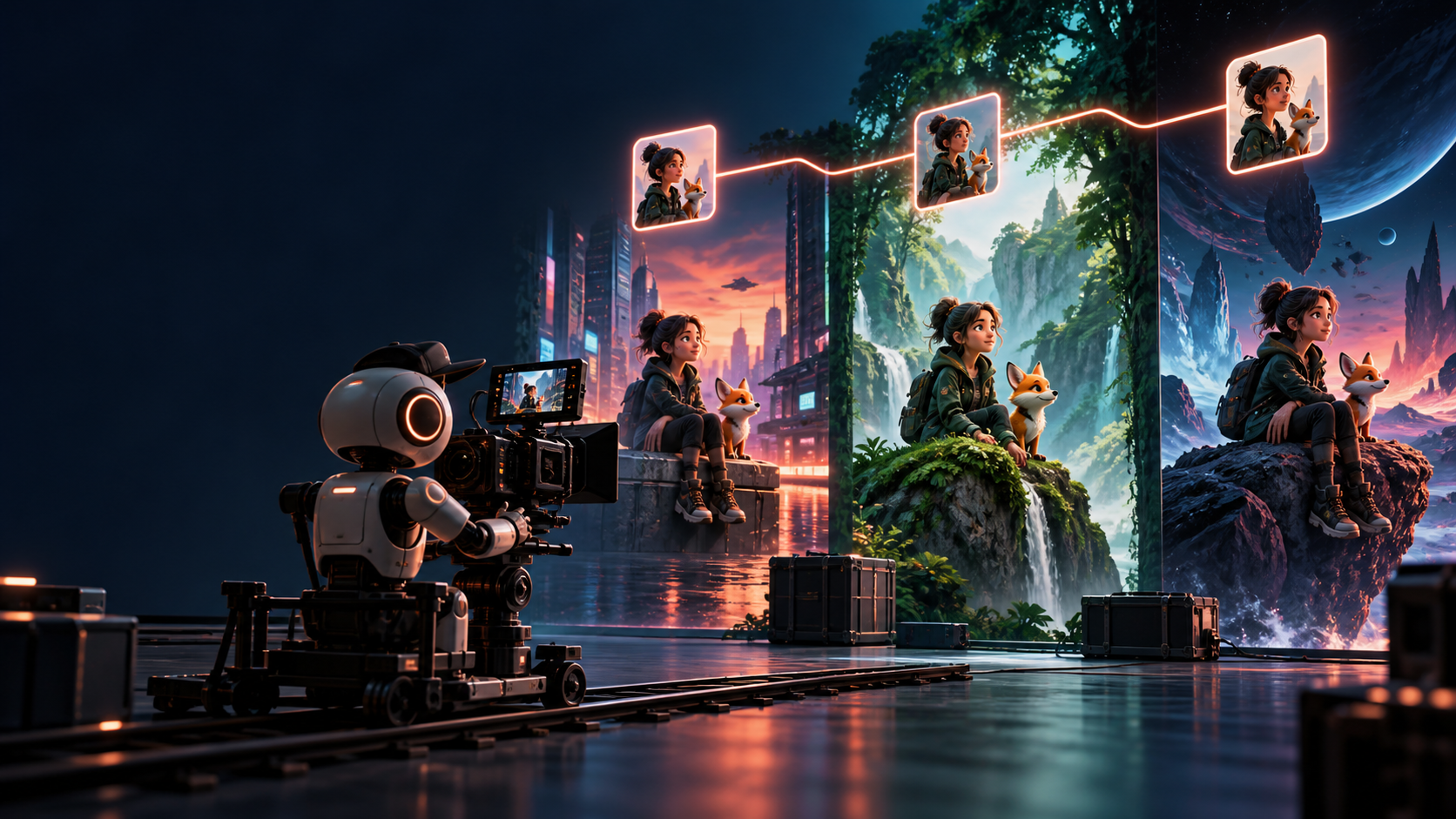
Runway is a media-production environment combining generation with reference-driven character/object/location work and post-production-style transformations. This lab tests where it earns its place — and where an ordinary timeline still wins. Refresh exact model and tool names at lab time.
Prerequisites
- A small reference board: character/object/location stills plus one style frame (reuse Class 57–58 or 59.4 sheets).
- A two-shot story need (same subject, two angles or two beats).
- A 59.A card with the shared brief.
Workshop path
1. Build the reference board. Name files, note must-preserve facts. Record which reference controls the current interface offers. 2. Generate a single controlled shot. One action, one camera move, bundle attached. Save settings, versions, cost. 3. Create the second angle preserving subject and world — carry references forward rather than re-describing in words. 4. Test a post-production/editing transformation only if it serves the story (background, cleanup, style transfer, object work). Ask first: does this solve a visual story problem, or is it decoration? Ordinary cuts, captions, timing, and audio usually still belong in a standard timeline (59.H). 5. Bring selects into a short edit. 15 seconds: hook → proof → close, hand-corrected captions, one CTA, phone check.
The reflection (required, short)
Write 5–8 lines: what did Runway solve better than your fallback (reference hold? transformation? speed?) and worse (cost? artifacts? export? learning curve)? Name the next job you would route to each. A lab without this comparison is a demo, not a decision.
Worked mini-example + when not to transform
Two shots, one subject: shot one, medium of your character in the approved location; shot two, close-up of the same character handling the product — references carried, not re-described. Attempt a post-transformation (say, background cleanup or a subtle style pass) only when the story needs it — e.g., a distracting background harming the proof shot. Skip the transformation entirely when a hard cut, a reframe, or a real photo would solve the problem in half the time; generative post is a specialist, not a default. Record the board files, both directions, settings/cost, winners, the transformation attempt with its before/after verdict, and the routing decision for next time.
Reference discipline (where Runway labs usually fail)
References only work when they are authoritative: one hero still per subject, named and frozen — not five near-duplicates that disagree about color. Before generating, check the board against the must-preserve list (face, wardrobe, label, palette, light grammar); after generating, freeze two frames per shot and compare them against the board pixel by pixel at phone size. Common saves: dropping the weakest reference rather than adding a sixth; shortening the clip when the second half drifts; locking the camera when the subject already moves. Log each save — "removed style frame v3, drift stopped" — because that line is reusable craft, while the clip itself is single-use footage.
Comparison prompts (answer in writing)
- Which shot held identity better, Runway or the fallback — with frame evidence?
- Which transformation, if any, solved a story problem nothing else could?
- Which system was cheaper per usable second, and which was faster wall-clock including retries?
- For the next three jobs on your calendar, which environment gets each — and what would flip the call?
Verify fast
Freeze both shots side by side: same subject, same world, proof legible? Then read your reflection aloud — does it route the *next* job, or merely praise the tool? Log interface recheck date; Runway's surfaces change quickly.
ARTICLE DISCUSSION
JOIN THE
CONVERSATION.
Got a question, a take, or a better way to do this? Log in and leave a comment.