
September 13, 2026
ENTERTAINMENT, LIKENESS, COPYRIGHT, AND AUDIENCE TRUST
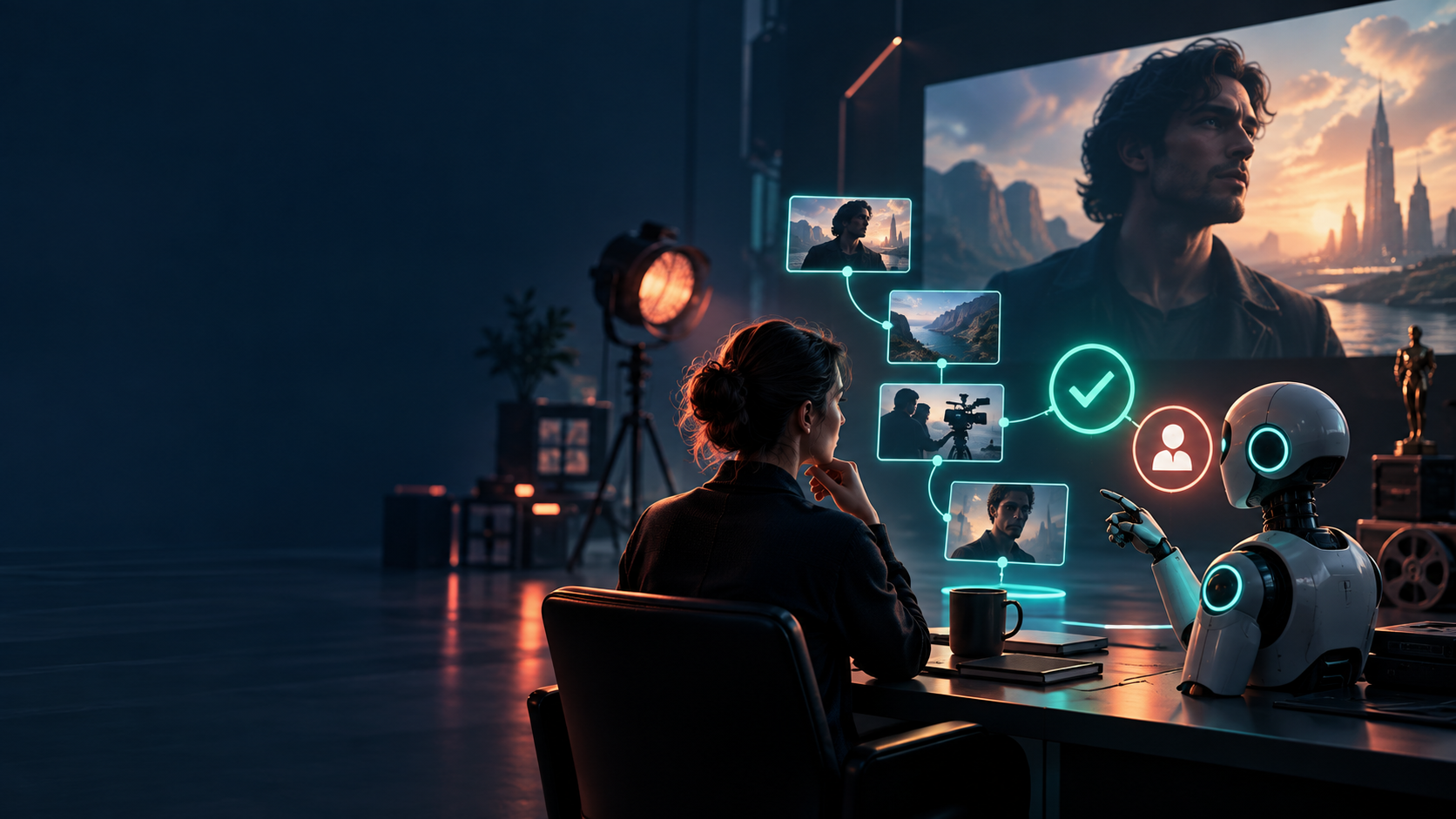
Lessons 60.1 and 60.2 taught you to explore cheaply and staff honestly. This lesson draws the boundary that makes all of it safe to publish: permission and trust. You can generate almost anything. That is exactly why the audience needs to believe what you show them — and why the people in your material need to have agreed to be in it.
By the end of this lesson, you can run the four operating questions on any entertainment asset, explain likeness and permission in plain language, and complete a pre-publication checklist saved as MEDIA-PERMISSIONS-AND-TRUST.md.
Four operating questions for every asset
This is not a legal lecture. It is a production habit. Before any image, voice, clip, song, or scene ships, ask:
1. Who created or provided this asset? Name the source: filmed by us, licensed from a library, generated from our own approved inputs, provided by a contributor — or unknown. 2. Do we have permission to use this person, voice, or material? A recognizable face, voice, private location, artwork, or song needs consent or a license that covers this use. "Found it online" is not permission. 3. Could a reasonable viewer be misled about what is real? Would they think a synthetic event happened, a real person said something they did not say, or a result was achieved that was not? 4. What needs a label or an alternative asset? If the answer to question 3 is yes, either label it clearly or replace it with something that does not mislead.
Run these in order. Question 1 without question 2 is how unlicensed material slips in. Question 3 without question 4 is how a team ships a problem it already noticed.
The vocabulary, in plain language
- Likeness. A recognizable person — face, voice, or distinctive features. Using it commercially or in a way that implies endorsement generally needs that person's agreement.
- Consent. The person's clear permission for a specific use. Consent to be filmed is not consent to be cloned, dubbed into another language saying new words, or placed in a different scene.
- License. Written permission from the rights holder stating what you may use, where, for how long, and in which contexts. A license for internal previs is not automatically a license for public release.
- Public-domain material. Work whose protection has expired or was never applicable, usable without a license — but verify the specific version. A new recording of an old song, for example, has its own rights.
- Synthetic performance. A generated or altered portrayal of a person saying or doing something they did not actually say or do. Useful for fiction with disclosure and consent; dangerous when presented as record.
- Disclosure. Telling the audience what they are seeing: dramatization, illustration, generated stand-in, temporary voice. Short, visible, and near the claim — not buried.
- Provenance. The record of where an asset came from and what was done to it: source, tool, prompt or edit notes, date, approvals. Provenance is how a future collaborator — or a challenger — checks your work.
Why trust is a creative asset
Surprise and spectacle are good. A plot twist, a creature reveal, a stunning transition — the audience came for those. They stop coming when they feel tricked about things that matter:
- A real person. A synthetic cameo, cloned voice, or face swap that suggests someone appeared in, said, or endorsed your work when they did not.
- A real event. Footage or audio framed as documentation of something that never happened.
- An endorsement. A fabricated review, fan reaction, or expert quote.
- A result. A before-and-after, demo, or outcome your product, method, or story cannot actually deliver.
The rule fits on one line: spectacle is fine; deception about a person, event, endorsement, or result kills the thing you are building. Audiences forgive a rough effect. They do not forgive learning the emotional moment was manufactured from someone's identity without permission, or the proof was never proof.
The pre-publication checklist
Use this on every publishable asset, not just the risky ones.
1. INPUTS — Are all inputs original, licensed, or authorized?
   Source for each visual, voice, music, and reference: ________
   License/consent covers THIS use (public, commercial, duration): yes / no
2. CLAIMS — Is every factual claim approved and supportable?
   Claims made: ________  Evidence held: ________
3. ENDORSEMENT — Does anything imply a person or brand endorses this?
   Faces/voices/brands shown: ________  Permission on file: yes / no / n/a
4. EVIDENCE VS. ILLUSTRATION — Can the viewer tell which is which?
   Real documentation labeled as such: yes / no / n/a
   Generated or dramatized material labeled near the moment: yes / no / n/a
5. CREDITS — Is the source and credit record complete?
   Provenance logged (source, tool, date, edits): yes / no
6. OWNER — Has the named approver signed off?
   Approver name + date: ________
If any line is "no," stop. Replace the asset, narrow the claim, add the label, or get the permission — then re-check.
Build it: audit a fictional clip, then write the file
Exercise in two parts.
Part A — audit. Take this fictional clip idea: a 45-second promo for a harbor food festival. The draft uses a drone-style generated harbor flyover, a voiceover that sounds like a famous local chef, crowd shots with recognizable faces pulled from a photo library "free download" page, a text claim ("the city's biggest festival — 50,000 attended last year"), and background music from a sample pack with unclear terms.
Choose a safe production path for each asset:
| Asset | Problem | Safe path |
|---|---|---|
| Harbor flyover | Viewer may read it as real footage of this year's site | Label as illustration, or replace with licensed/shot footage of the actual location |
| Chef-like voiceover | Implies endorsement by a real person | Hire a licensed synthetic voice or a voice performer; never clone the chef without a written agreement covering this use |
| Crowd faces | Unknown license; recognizable people | Use licensed crowd material with cleared commercial terms, or blur/replace unidentifiable; file the license |
| "Biggest / 50,000" claim | Needs a source | Verify against organizer or press record; soften to what evidence supports, or cut |
| Music | Terms unclear for commercial festival promo | Replace with a library track whose commercial license you hold, or a commissioned bed; file the terms |
Part B — write the file. Create MEDIA-PERMISSIONS-AND-TRUST.md for a real project of yours — the short, explainer, or promo from Lessons 60.1–60.2. Use this structure:
# MEDIA-PERMISSIONS-AND-TRUST

## Project
[title, format, intended audience and placement]

## Asset register
| Asset | Source / provider | Permission / license | Covers this use? | Label needed? |
| --- | --- | --- | --- | --- |
| [e.g. harbor plate] | [shot by us / library X / generated from own refs] | [agreement or license ID] | [yes / no] | [none / "illustration" / "dramatization" / "temporary voice"] |

## Operating answers
- Who created/provided each asset: [summary]
- Permission status: [all cleared / gaps listed below]
- Could a viewer be misled: [where, and the fix]
- Labels or replacements: [exact wording and placement]

## Pre-publication check
- [ ] Inputs original/authorized, license covers this use
- [ ] Claims approved and evidenced
- [ ] No implied endorsement without permission
- [ ] Evidence separated from illustration, labeled near the moment
- [ ] Source/credit record complete
- [ ] Owner approval: [name + date]
Check your understanding
1. A contributor agrees to be interviewed. Does that let you clone their voice for new sentences in the trailer? Why or why not? 2. Your generated establishing shot looks like real drone footage of a real festival. What are your two compliant options? 3. Where must a disclosure appear, and why does a credit buried at the end fail the test?
Common failure mode: a complete-looking checklist with "unknown" still in the permission column. Unknown means not cleared. Replace the asset or get the agreement before the owner signs.
The finish line
You are done when a real project has a concise MEDIA-PERMISSIONS-AND-TRUST.md: every asset sourced, permission confirmed for this use, misleading readings fixed with labels or replacements, credits recorded, and a named owner's sign-off. That file is the production boundary from the Class 60 outcome — the line between what generative media makes possible and what a trustworthy production ships.
Class 60 in one sentence: previs before payment, owners beside every tool, and permission before publication. Carry all three into Class 61, where voice and audio put a recognizable human presence in front of the audience — and every choice in this lesson gets louder.
ARTICLE DISCUSSION
JOIN THE
CONVERSATION.
Got a question, a take, or a better way to do this? Log in and leave a comment.